HIDE AND SEEK

Paintings by Katrin Kampmann

14 / 08 / 26 until 04 / 10 / 26

Katrin Kampmann’s paintings do not seek to depict an orderly world that can be easily interpreted. Her works are psychographic landscapes, emotional condensations, and chromatic explosions. At the center of the exhibition is the large-format diptych “Hide and Seek”—a work that immediately draws the viewer into a visual labyrinth of color, texture, and hidden figures.
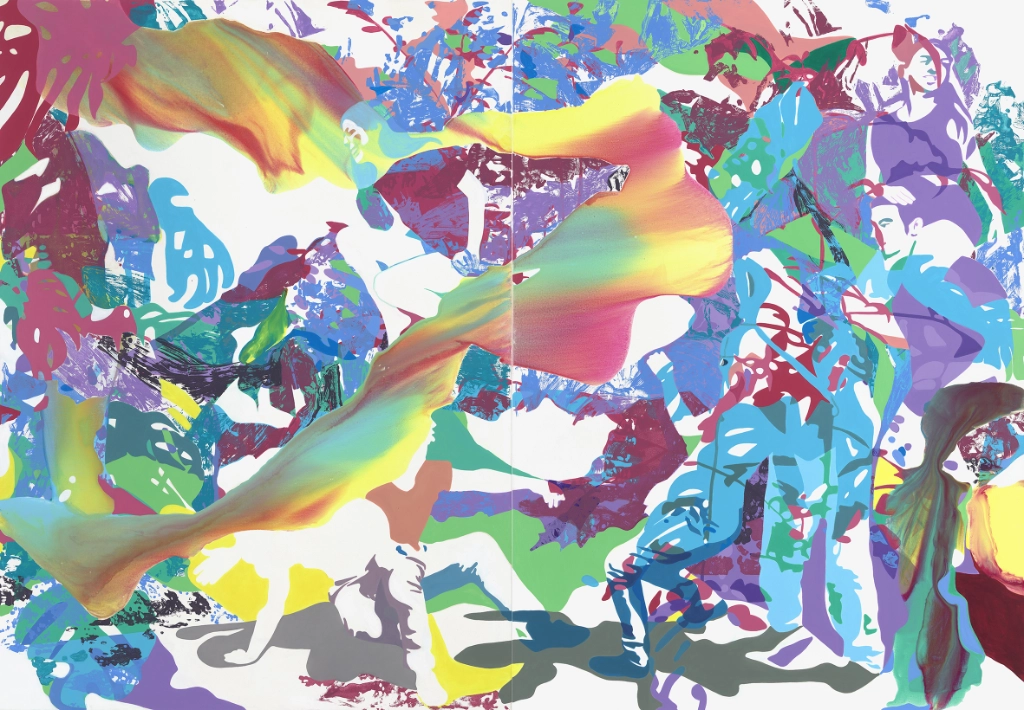
Hide and Seek. Malerei von Katrin Kampmann in der Zagreus Koch Kunst Galerie
Detail: Hide and Seek, linocut and oil on canvas, 250 x 360 cm, 2026

The eye is not invited to linger gently. Instead, the gaze wanders, leaps, and dances across the canvas. Searching, losing oneself, and finally finding oneself again. The artist rejects a simplistic, clear, linear representation, opening up an associative space of resonance in which forms seem to dissolve again even as they are being created. As with a Rorschach test, we do not encounter Kampmann’s painting with a neutral gaze, but rather through our own temperament and unique experiences.

www.katrinkampmann.com
www.instagram.com/kat_kampmann

The Galettes des rois menu draws inspiration from the game of hide-and-seek and the flow of colors.
 
Yellow / Green / Red / Orange
Polenta / Herbs / Bell peppers / Saffron
 
“Hide and Seek”
Swiss chard / Fish / Savoy cabbage / Meat / Crêpes
 
Galettes des Rois

Flyer Hide and Seek. Malerei von Katrin Kampmann in der Zagreus Koch Kunst Galerie

RECONNAISSANCE OF THE LIP-FLOWERED PLANTS

RECONNAISSANCE DER LIPPENBLÜTLER. Malerei und Installation von Eva Schwab in der Zagreus Koch Kunst Galerie.

The exhibition “Reconnaissance of the Lip-flowered Plants” explores the recognisability of the lip as a symbol of origin, power and beauty. From the ‘Habsburg lip’ as a courtly feature, the trail leads into the present day – to the invasive lip booster, the digital standardisation of faces and the longing for individuality in a world of standardised beauty. As with the flowers of the Lamiaceae, whose distinctive lower lip serves as a landing strip for insects, a play of seduction, mimicry and function unfolds.

Between genetics and performance, portraiture and selfie culture, a space of recognition emerges in which family resemblance, digital facial recognition and self-presentation intertwine: between Rudolf and Rosemary, Karl and Sage, Margarethe and Lemon Balm.

Leopold. RECONNAISSANCE DER LIPPENBLÜTLER. Malerei und Installation von Eva Schwab in der Zagreus Koch Kunst Galerie.
Leopold, Enkaustik, Tusche, Öl auf Nessel

Eva Schwab’s installation combines wall hangings, ceramics and encaustic painting into a multisensory, interactive performance. Ulrich Krauss’s ‘Gelockte Knödel’ menu complements the sensory experience: a culinary allegory that combines Habsburg recipes with Lamiaceae flavours, a multisensory exploration of the Lippe region at the intersection of art, cuisine and culture.

Studio Eva Schwab

RECONNAISSANCE DER LIPPENBLÜTLER. Malerei und Installation von Eva Schwab in der Zagreus Koch Kunst Galerie.
 

To the exhibition we serve the menu


CURLY DUMPLINGS
and the imperial cuisine of the Habsburgs

Basil – Thyme – Rosemary – Oregano – Sage – Mint – Lavender – Marjoram

Beef soup and pancakes with Lamiaceae
Vegetarian: Vegetable consommé with pancakes
2023 Domaine Arsac Viognier Les Amandiers

Steamed salmon trout with pink asparagus and lavender sauce
Vegetarian: Beetroot with walnut oil, pink asparagus and lavender sauce
2021 “Ninte de Ninte” Bianchetta Genovese, Liguria, biodynamic

Guinea fowl Halbthurn-style
with saffron, ginger, cumin, coriander and cinnamon
Dumpling filling with Lamiaceae and Duchesse potatoes
Vegetarian: Blanc Manger with baked celery and almond sauce
2020 Rasteau, Domaine de Verquière, Rhône

Strawberry and champagne soup
with pineapple and vanilla parfait


TOPOGRAPHY

TOPOGRAPHIE Teller und Malerei von Zuzanna Skiba in der Zagreus Koch Kunst Galerie

Plates and paintings by Zuzanna Skiba

06 / 06 / 25 to 26 / 07 / 25

Zuzanna Skiba works on a complex of works based on memories as well as on concrete experiences.
She often creates serial works that are examples of mental cartography. They are inner and outer landscapes that can constantly change. In this way, she observes the world with all its topographical, political and personal information.

The series of works depict a combined view from different perspectives: from above, from the centre, or from below. The result is a mental landscape with the fascination of the endless cycle.
For the Zagreus project, Zuzanna Skiba has created a series of ceramic plates that also represent a topography as a carrier for food. The individual foods and dishes are applied to the plate according to the specifications, creating an edible landscape.

TOPOGRAPHY 1/20, 2025
Clay modelled & glazed | diameter approx. 36 cm


To the exhibition we serve the menu “Foodpainting”

Hummus with garlic and cumin
Red onion marmalade with star anise
Aubergine puree with orange and cumin
Labneh with olive oil and lemon
Jalapeños with cinnamon and orange
Tapenade with green olives, anchovies, garlic
Roasted minced lamb and walnut, roasted sesame seeds

2023 Domaine Arsac, Viognier Les Amandiers, Ardèche

“Layering”

Polenta with parmesan
Indonesian peanut sauce
Veal steak
Pickled onions with salt and apple cider vinegar
Salad
Pesto
Sea bream fillet
Oyster sauce
Fried prawn
Choron sauce

2023 Domaine 4 Vents, Pichounette, northern Rhône

Lemon and spruce sprout granitée
Strawberries and blueberries with cassis
Apricot sauce with vanilla

2021 Hubert Lay, Pinot Gris Auslese SL, Kaiserstuhl

am rande der nacht

am rande der nacht
Paintings by Sador Weinsčlucker

04 / 12 / 24 to 08 /02 / 25

Martin Oswald on the still lifes by Sador Weinsčlucker

If you only look at the light in the pictures at first, you might think that the artist is transporting us to another time: the dark painting, out of which the objects that Sador Weinsčlucker stages in his still lifes shine, has a baroque feel. Some of them hint at aspects of transience: but the artist is not content with broken bowls, cracked plates or overturned glasses as we know them from the vanitas paintings of the Dutch. Eight roofing nails join a sledgehammer under the title “bleib noch”, a recently discarded fork lies lost on a book between fruit and all kinds of bottles, there is disorder on a kitchen preparation table, as if someone deliberately wanted to leave a mess behind. The title “here again” could just as easily be written on a small note left there.

What Sador Weinsčlucker presents to us are open stories, torn out of a narrative that we do not know. They resemble film stills, bathed in a transfigured, ghostly light that encourages us to speculate about what was, what is to come, in short, about ourselves and our restless, fragile world. In fact, the title of the exhibition is borrowed from a touching French film by Claude Berri: in a single night, a great deal breaks open, the past is remembered and creeps into the present lives of the protagonists. Sador Weinsčlucker’s pictures are also touching: through the sensual touch of the objects depicted, their fruity or tart taste, their sharp edges and points, they allow us to almost physically feel what we see, to immerse ourselves in what has happened before or what is about to happen. They are silent images that move us.

Martin Oswald is an author and artist. In spring 2025, Kröner Verlag will publish his
novel “Kafka hat am Sonntag geschlossen. Beobachtungen eines Flaneurs”.

To the exhibition am rande der nacht

we serve the menu Singspiel

Zarzuela de Mariscos
(Seafood operetta)

Sea bass, langostinos, prawns, mussels
In a sauce of tomatoes, almonds, saffron, white wine, lemon and brandy

2020 Signature Muskateller, Seitz winery, Nahe

Cocido Madrileño
(stew, but everything is served separately)

Chickpeas, potatoes, semolina dumplings, carrots, turnips, beans, white cabbage,
veal shank, marrow bones, chorizo, wild duck (ingredients may vary)

2023 La petit Commanderie “le reveille matin” Languedoc

Fruit platter with dates, pomegranate, oranges, pears, quinces and grapes
Crema catalan

FRUITS OF THE PERFECT CIVILIZATION

Pictures by Peter Boué

25 / 10 / 24 to 30 / 11 / 24

In the landscapes, which are always drawn in black and white and which, strictly speaking, are largely fragments or impressions of landscape and urban phenomena, the difference between nature and culture seems to be suspended: in an ambiguity that defies any attempt to pin it down and refuses a clear resolution. Their chiaroscuro of grainy black and white shades often puzzles us. As a kind of pre-form, it emerges from the primordial ground of nature before the advent of human culture. Others, however, emerge from precisely this man-made culture.

In this way, the cyclical energy of life and the constantly renewing nature can be seen, which carries the light in the dark and the coming in the past. Nature is also nourishment, offering protection and opportunities in all its unhomeliness. In the drawings, natural and cultural events are visualized as intertwined phenomena – as if on a stage on which she illuminates transience and endurance, close to the Baroque symbolism of vanitas.

Nature and culture are also the two elements that make up the art of cooking. Both are eternally in flux and the past permeates the present in perception, analysis and preparation.

To the exhibition we serve the following menu
Texture – Metamorphoses

To the reception

Casa Geller brut Spumante, Veneto

Endive salad with potato dressing and egg,
Cuttlefish braised in its own ink with aniseed and juniper
Vegetarian instead of cuttlefish, fried salsify coated in spices

2020 Kreuznacher Paradies Riesling, Steitz winery, Nahe

Stuffed and gratinated spaghetti squash with saffron, parmesan and crème fraîche
fermented Treviso and chicory with maple syrup, apple and chili

2013 Riesling Fasslagerungf, Alexander Heer, Rheingau

Polenta with shallots, garlic and parmesan,
Venison ragoût with red wine, various mushrooms and red onion marmalade, cranberries
Vegetarian instead of venison, braised roots in red wine with mushrooms and red onion jam

2022 Unplugged Pinot Noir, Weinhaus Kreuzberg, Ahr

Teurgoule from Normandy (baked rice casserole with cinnamon and vanilla)
Fermented honey sauce with elderberry syrup

DAWN

Painting and installation by Junko Wada

23 / 08 / 24 to 20 / 10 / 24

With dance performance Eos by Junko Wada
Music by Hans Peter Kuhn

It all started when I picked up the book ‘The Burning Green Tree – Vacillation’ by Kenzaburo Oe from my bookshelf in February last year. It is about events in his home forest. No sooner had I started reading it than I received the news that Oe had passed away and it seemed to me that his soul had travelled around the world before his death and influenced me, among others, to finally read his book.

In all his books, he refers to Dante’s ‘The Divine Comedy’ and I felt compelled to read this famous book as well. I realised that the book was difficult to read without knowledge of Greek and Roman mythology, so I had to re-read the books I had on the mythologies. I was fascinated by the unique characters and stories of the gods and heroes and have spent a lot of time in the ancient world of Europe over the past year.

When I visited the space for the exhibition at Zagreus in February this year, I came up with the idea of small-scale works going across the walls in the form of a frieze. It was a natural development, arising from the architectural conditions, but at the same time I was inspired by the study of ancient mythologies to deal with portraits and stories of Greek and Roman gods and heroes and to make them the subject of the paintings.

After I had completed many of these small works, I chose one of the gods for the last wall and painted him in large format. I was surprised that the god I chose, Dionysus, was the same god as Zagreus.

Zagreus means ‘the subterranean hunter’ and in his origin myth he is dismembered, cooked and eaten by the Titans. Afterwards he is in the underworld and is then reborn as Dionysus.

www.junkowada.de / instagram: thisisjunkwada

We serve the menu

GODDESS DISHES
A menu combining Japanese and Greek dishes

Unagi Bento

Braised eel in soy sauce, sake, mirin and sesame seeds
Kritaraki with fermented tomato, parmesan and egg
Vegetarian: braised eggplant with soy sauce, sake and mirin instead of eel

2017 Rkatsiteli Qvevri Corporation Kindzmarauli, Georgia

Tempura and tzatziki

Tempura with vegetables, sesame leaves and shrimp,
Yoghurt with cucumber and garlic, wasabi cream with orange and lime

2018 Hugel family, Pinot Blanc Classic, Alsace

Prometheus + Dionysus

Poached saddle of beef in red wine and spices, kombu with jelly,
Sushi rice with vine leaves, braised onion in honey
Vegetarian: beet in red wine and spices instead of meat

2020 Domaine Arsac Messis Ultima, Ardèche

Mastic parfait, grapes with olive oil and sea salt, quince bread

2021 Mandelbaum Riesling Auslese, Steitz winery, Nahe

GO CHASING RABBITS

GO CHASING RABBITS

Paintings and Installation by Birgit Fechner
plus Texts by Christiane Radeke

13 / 06 / 24 to 18 / 08 / 24

The song “White Rabbit” by Jefferson Airplane from 1967 is the starting point for the collection of ideas for the expansive installation with gestural, abstract paintings, text fragments and mixed-media collages made of paper, wood and porcelain. The song from the flower power era refers to drugs, but above all it is an homage to Alice in Wonderland. “Go Chasing Rabbits” is a line from the song. Little Alice runs after the white rabbit, she doesn’t really know why, but the desire to embark on a journey into the unknown is stronger than the fear of it. The title stands for a longing for life, colourfulness and beauty, associative, free and subjective.

www.birgit-fechner.de
“My art is always a kind of path, a search, something processual, a chasing rabbits.”


Menu Kräftespiel

to the reception:

2022 Tre Dame IGT Rosato, Cà de Noci, Emilia Romagna

on WOOD

Baked calf’s head
Leaves, herbs, flowers and sprouts
Pink onions
Yoghurt dressing
Beluga lentils
Herb cream

Vegetarian: baked celeriac with miso instead of veal head

2020 Signature Muskateller, Steitz Winery, Nahe

on KERAMIK

Braised ox cheeks with rosehip and red wine
Pasta and dumplings
Cauliflower with fir tip oil
Beetroot
Chanterelles

Vegetarian: Instead of ox cheeks, carrots with red wine and rosehip

2021 Cabernet Moravia (Cab. Sauv+Zweigelt), Zdena Cacikova, Czech Republic

on GLASS

Blackcurrant ice cream
Maple ice cream
Pear
blackcurrant
elderberry
Rose petals

2021 Mandelbaum Riesling Auslese, Steitz Winery, Nahe

PAINTING

by Guisun Jang

03 / 02 / 24 bis 07 / 04 / 24

Serenity and time are important elements for me when painting.
The moments of joy, for example when looking at a ray of sunshine,
of clouds or buds, which gradually express themselves in new colours.


Accompanied by the menu Fermentation and time.

Kimchi soup

Sweet potato, smoky fish sauce, shiitake mushrooms, Iberico with light miso
Vegetarian: smoked tofu instead of Iberico
2018 Malvasia Dva Duby 16 mon. medium oak barrels, Czech Republic

Dot and spot

Lacto-fermented red cabbage, mussels in beetroot miso,
fermented porcini mushrooms and tomatoes, radish kimchi
Vegetarian: beetroot instead of mussels
2016 Domaine Arsac Argente, Chradonnay, Ardèche

Sauerkraut

Barrel sauerkraut with apple cider and fermented butter,
Mashed potatoes with fermented whey,
fried sea bass with shiro miso and sesame seeds
smoked paprika oil
Vegetarian: baked celeriac instead of sea bass
2012 Kioupi Amphore Pinot Noir, Alexander Heer, Rheingau

Lacto honey

Ice cream with lacto honey, mango and chilli,
miso cream, whipped apricot sauce and pickled pine nuts

ONE MORE TIME

ONE MORE TIME

Sculptures Gabrielle Rossmer
Film Luther Price
Painting Sonya Gropman

05 / 03 / 20 until 14 / 04 / 20

This exhibition is about the object – specifically related to cooking and eating – as it embodies time, place, and meaning. Time (both present and past), place (here, in Germany – and there, in the U.S.), and meaning (the human experience including nourishment, loss, connection to the land, emigration, re-connection, creation, recreation). This exhibit is about today, as it has been informed by the past; about welcoming our own history as part of a living present.
When the Rossmer (nee Rossheimer) family (Gabrielle, a one-year old baby, along with her parents Erna and Stefan) fled Nazism in 1939, all of the objects from their home – from furniture, to linens to kitchenware — travelled in a lift van (a large, wooden moving crate) to New York City. Most of these objects survive today, and have been in continual daily use since then. There is an irony to the Nazi law which required Jews to pack their household items and then pay a tax on them (their own belongings!), as a way to create a discontinuation of Jewish life in Germany; this actually led, in our family at least, to a sense of continued connection to our family’s former life in Germany.
All three artists explore the same objects from different perspectives and in different media –sculpture, film and paint. Gropman’s work is brand new, Price’s is archival and Rossmer’s is new work that reflects its own history.

Rossmer and Gropman are mother and daughter. They are the co-authors of “The German Jewish Cookbook: Recipes & History of a Cuisine”, (2017, Brandeis University Press). They wrote it to preserve a food tradition that has largely faded, along with the culture of German Jews. Those who survived the 1930’s have almost entirely merged with the cultures of the lands to which they immigrated. The kitchen is the place where German-Jewish culture has been most clearly preserved, with families often maintaining some of the recipes of their mothers, grandmothers, and great-grandmothers (and sometimes, as in our family, grandfathers). That might include dishes for Passover (Pesach), the eight-day holiday that celebrates liberation and prohibits leavened food; Chanukah, when fried foods are eaten; Berches, the bread eaten for the weekly Sabbath, or other holidays.

Gabrielle Rossmer is a sculptor. In 1991 she created a multi-media installation entitled “In Search of the Lost Object” that was about her family’s history in Germany and subsequent emigration to the U.S. This work was exhibited in the city of her birth, Bamberg, Germany as well as at the Cathedral of St. John the Divine in New York City in 1994-5, and as part of the exhibition, “Witness and Legacy, Contemporary Art about the Holocaust” which travelled to many venues in the USA from 1995 to 2002. (Elements of this show are on permanent display in the Bamberg Historical Museum.) Rossmer’s work here is a continuation of where she left off 18 years ago. These sculptures are composed of colorless stiffened cloth. They refer to household objects, and are largely recognizable, yet have a fugitive, evasive quality which evokes past time. Rossmer lives in Massachusetts, USA

Luther Price is an experimental filmmaker whose work has been widely screened at museums and galleries in the U.S. and Europe, including the Museum of Modern Art and the 2012 Whitney Biennial, both in NYC. In Europe, his films are distributed by Light Cone in Paris. In 1991 he shot super 8 footage related to Rossmer’s “In Search of the Lost Object”, which included both household objects, and several members of the family. He created a 15-minute film from the footage, which is also titled “In Search of the Lost Object”. Price said “The objects were speaking to me when I filmed them. It knocked me over to know all these objects made it here (the U.S.). Objects hold so much meaning…in a way they are living.” Price’s film is screened in the gallery on a 15-minute loop. He lives in Boston, MA, USA

Sonya Gropman is a visual artist and writer. She has exhibited her work in the U.S. and published her writing in food-related publications in the U.S. Her work here focuses on the cooking utensils and foods that represent her family’s history, yet also reflect her daily activities in her own kitchen. She is interested in the connection to a place via food. Her images, painted directly onto the gallery wall, are silhouettes rendered in bright colours. The images are repeated, to create a stylized pattern that teeters between vintage and contemporary. Gropman lives in New York City.


powered by Reuther-Media